








 ALL PROJECTS
 ALL PROJECTS
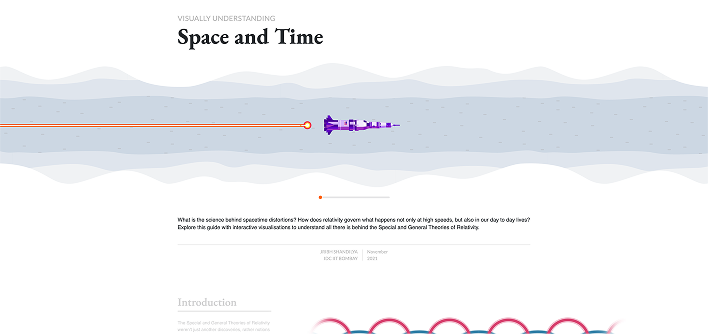
Visually Understanding Space and Time
November 2021
Introduction
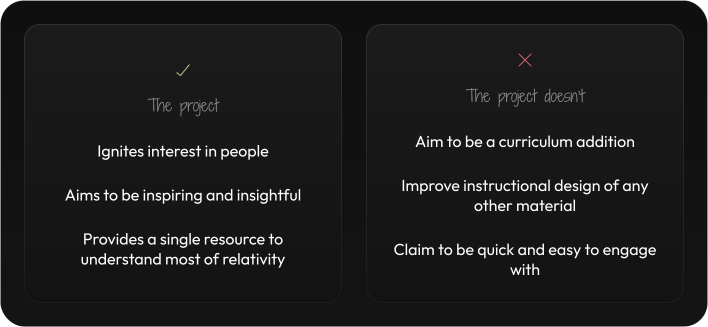
The project aims to visually and interactively explain the behaviour of Space and Time (as covered in the Theory of Relativity by Albert Einstein) to a general audience.
The outcome is an interactive online article licensed under the Creative Commons License.
Check the website out below, or keep reading for the project details and processes followed.
 Go to Website
Audience and Aim
The product is targeted mainly for people who have finished high school education, which would include:

It aims to encourage learning and exploring ideas from a new perspective.
Why Relativity?
Efforts to visualise and explain relativity to the general public have relatively been less. Theory of Relativity turns classical physics and centuries of assumed notions upside down. It’s a sufficiently complex topic, and yet is quite famous among non-scientific circles.
Literature Review
The project aims to visually and interactively explain the behaviour of Space and Time (as covered in the Theory of Relativity by Albert Einstein) to a general audience.
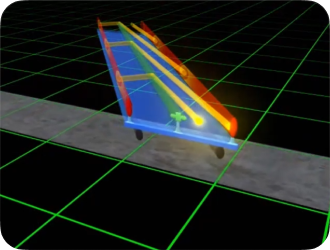
Photon Cart
A non-interactive YouTube video that visualizes non-simultaneity of special relativity
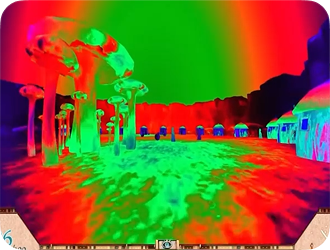
A Slower Speed of Light
A game developed by MIT Game Labs that shows effects of special relativity if light moved much slower.
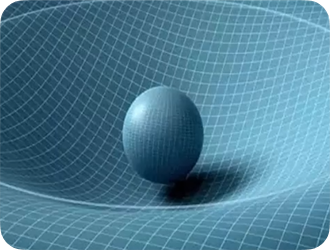
Stretched Sheet
Shows spacetime as a fabric that is distorted by the mass on it. Struggles to explain what is pulling the mass down, as well as the gradient in time.
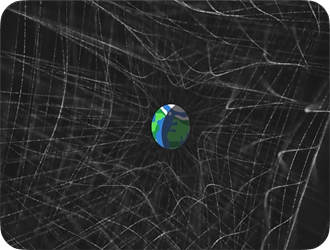
3D Visualization
Shows all space dimensions and time dilation, but doesn't explain how time dilation causes gravity.
Although these visualisations are good for explaining individual phenomenon, but nothing ties them together to explain the whole picture.
The Product
The interactive web article, licensed under a Creative Commons License, walks us through different 2D and 3D visualisations that can be tinkered with to get a good understanding of the Special and General Theories of Relativity, and can be easily understood by anyone with a high school education and sufficient curiosity.
Go to Website
Feedback from Experts
What are embedding diagrams?
In the web article above, you’ll encounter a concept called embedding diagrams. These were introduced by L. Epstein in 1985 as a concept for the general masses, but no scientific explanation.
Dr. Rickard Johnson, an Astrophysicist in Chalmers University, Sweden built on these embedding diagrams, and developed the Dual and Absolute schemes for visualising concepts of relativity.
I got feedback from Dr. Rickard on the different types of embeddings and when to use them, how a black hole is formed in terms of embeddings, and how a black hole can be represented as a dual scheme embedding.
I also contacted Bartosz Ciechanowski, author of excellent interactive explanatory articles online for tips on how to avoid fast scrolling on the banner visualisation, clarity on the light propagation visualisation (Bartosz mentioned that using sine waves here would be better), and the rotation of the 3D model in the Geodesic visualisation
Usability test
I conducted an Information Retention Test via Google Forms.

The product got a score of 9.2 on the Likert Scale on how insightful they found the article to be. Users found embedding diagrams a bit tough to grasp in one go, while some issues with the page layout on different screen sizes were pointed out.
Reflections and Future Scope
If I were to do this again, I would like a more coherent UI across the interactive visualisations; current ones feel a bit scientific and bland.
I’d love to give this narrative a better bounding story. The current story of two friends can be made more engaging.
A few more relatable examples, like the merry go round, could help people can understand the complex topics better.
Check out the detailed project report.


